
PID Tests

Updated: Sep 30
A Photo-Ionisation Detector (PID) is a handheld instrument that detects volatile organic compounds (VOCs) in soil and groundwater. PID readings are essential on contaminated land investigations — they give an immediate indication of whether the ground contains harmful vapours.
When to Use
PID readings are typically taken from disturbed samples, split-spoon samples, or directly in trial pits. They are required on most brownfield sites and any investigation where contamination is suspected.
The form writes to the AGS IPID group. Each PID entry is one reading at one depth.
The PID Form
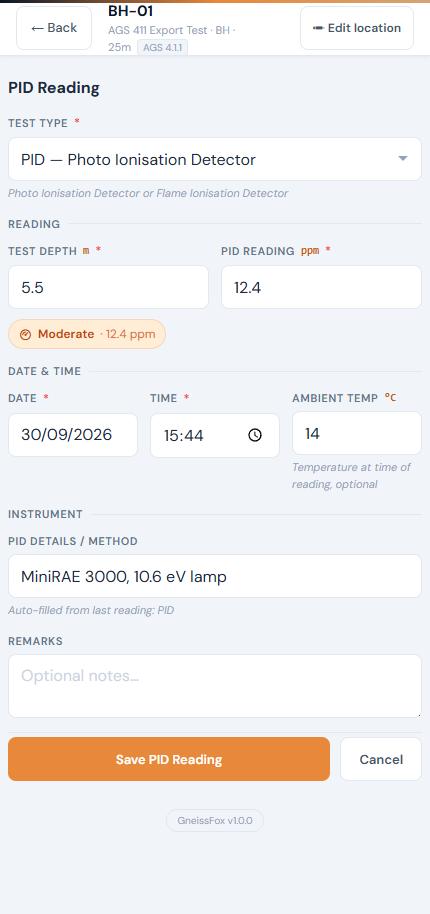
Test Depth (IPID_DPTH)
The depth at which the reading was taken, in metres. Required.
PID Reading (IPID_RES)
The reading from the PID instrument, in parts per million (ppm). Required.
Once you enter a reading, the app shows a colour-coded severity badge:
Item | Description |
|---|---|
No detection | 0 ppm. |
Trace | Less than 1 ppm. |
Low | 1 to 10 ppm. |
Moderate | 10 to 100 ppm. |
High | 100 ppm and above. |
These levels are purely informational to help you spot elevated readings in the field. They are not regulatory thresholds.
Date, Time & Temperature
Item | Description |
|---|---|
Date | Defaults to today. Required. |
Time | Defaults to now. Required. |
Ambient Temperature | In °C. Optional but useful because PID sensitivity varies with temperature. |
Instrument Details (IPID_METH)
Enter the PID serial number, model, or method used. This auto-fills from your previous reading at this location, so you only need to enter it once.
Remarks
Any notes about the reading — for example, the sample type, odour, or visual contamination indicators. Optional.
Tips
Calibrate your PID before use — readings from an uncalibrated instrument are unreliable.
Take readings as quickly as possible after exposing the sample to air — VOCs dissipate rapidly.
The instrument details auto-fill from your last reading, so check they're correct if you've changed instruments.
Record the ambient temperature — PID readings can be affected by cold or hot conditions.
High readings may indicate a health and safety risk. Follow your site-specific risk assessment.


Comments