
Hand Vane Tests

Updated: Sep 30
The Hand Vane Test (also called the Insitu Vane Test) measures the undrained shear strength of cohesive soils directly in the borehole or trial pit. It is quick, repeatable, and gives the engineer immediate information about soil strength at specific depths.
How It Works
A vane blade is pushed into the soil and rotated until the soil fails in shear. The torque at failure is converted to a shear strength value in kPa. Two types of reading are taken:
Item | Description |
|---|---|
Peak strength | The maximum resistance before the soil fails. This is the undrained shear strength (Su). |
Residual strength | The resistance after failure, measured by continuing to rotate. This shows how much strength the soil retains once disturbed. |
The form writes to the AGS IVAN group.
The Hand Vane Form
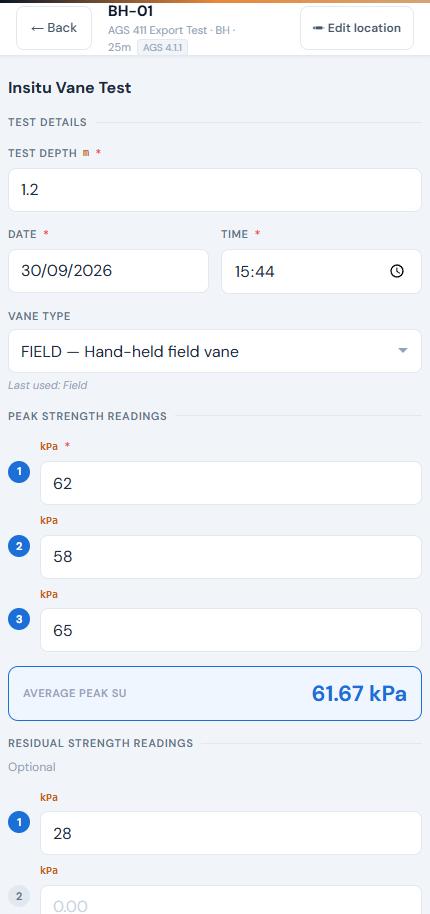
Test Depth (IVAN_DPTH)
The depth at which the vane was inserted, in metres. Required.
Date and Time
When the test was performed. Both default to now. Required.
Vane Type (IVAN_TYPE)
The type of vane instrument used. Select from the AGS standard list. If you used the same instrument as your last test, it auto-fills from your previous entry.
Peak Strength Readings
Enter up to 3 peak shear strength readings in kPa. At least one is required. The app auto-calculates the average of all entered readings and stores it as IVAN_IVAN (Average Peak Su).
Taking multiple readings improves reliability — if one reading looks unusual, the average smooths it out.
Residual Strength Readings
Optionally enter up to 3 residual strength readings in kPa. The average is stored as IVAN_IVAR (Average Residual Su).
Residual readings are not always required but are useful in clays where the engineer needs to understand remoulded strength.
Remarks
Free-text notes about the test conditions. Optional.
Tips
Take at least two peak readings per depth for better reliability.
The vane type auto-fills from your last test — check it's correct if you've changed instruments.
Residual readings are most useful in soft to firm clays. In stiff clays, the vane may not rotate smoothly enough for a meaningful residual.
Each reading shows a numbered indicator that fills in blue once a value is entered, so you can quickly see how many readings you've taken.


Comments