
Chiselling

Updated: Sep 30
Chiselling is used in cable percussion drilling to break through hard ground, obstructions, or stiff clays. This form records what tool was used, how long it was applied, and over what depth.
When to Record Chiselling
Record a chiselling entry any time the drilling crew uses a shell, chisel, auger, or other tool to break through material that can't be advanced with normal boring. This is common in stiff clay, gravel layers, and made ground with obstructions.
The Chiselling Form
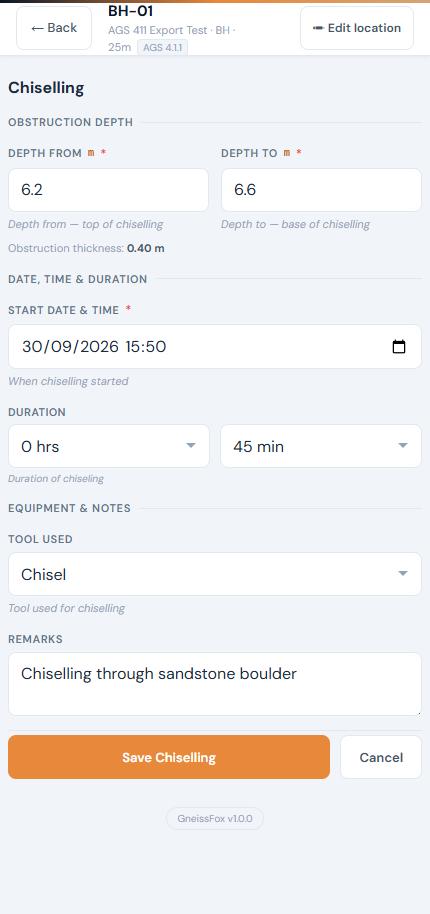
Depth From (CHIS_FROM)
The depth at which chiselling started, in metres. Required.
Depth To (CHIS_TO)
The depth at which chiselling finished, in metres. The form auto-calculates the thickness between these two values. Required.
Start Time (CHIS_STAR)
Date and time chiselling began. Uses a date-time picker. Required.
Duration (CHIS_TIME)
How long chiselling lasted. Set using separate hour and minute dropdowns — for example, 0 hours and 45 minutes, or 1 hour and 30 minutes. This is recorded in the AGS data and shown on the daily record.
Tool (CHIS_TOOL)
The tool used for chiselling. Choose from:
Item | Description |
|---|---|
Shell | A cylindrical cutting tool for clay and soft ground. |
Chisel | A heavy cutting tool for breaking hard obstructions. |
Auger | A screw-type tool for soft or cohesive soils. |
Other | Any tool not listed above. |
Remarks (CHIS_REM)
Free-text notes about the chiselling — for example, the type of obstruction encountered or how the ground responded. Optional.
Tips
Always record the tool used — this helps the engineer understand what the crew encountered at that depth.
If chiselling is prolonged, consider splitting into separate entries for each tool or depth interval.
Chiselling records appear on the daily record sheet alongside CP runs to give a complete picture of the day's work.


Comments